
Twelve Meters Under: Inside Extreme Tidal Oyster Farming in Brittany, France
If you’re an oyster explorer, it’s well worth timing your visit to Brittany’s Mont-Saint-Michel Bay with a super low tide. This past spring, I had the rare chance to do just that with La Famille Boutrais team.

Two oyster farmers walk along a row of oyster bags at low tide with Mont Saint-Michel anchoring the horizon beyond.
Oyster farming in Brittany has quite a long history. The region has been harvesting oysters for centuries, with Cancale celebrated for its wild flat oysters as early as the Roman Empire. Today, Brittany remains one of France’s main oyster-producing regions, though the focus now is mainly on the Pacific species (Magallana gigas).
What makes this coastline so well suited to oyster farming is its combination of strong tidal flows, clean, plankton-rich waters, and expansive, protected bays. Mont-Saint-Michel Bay, in particular, experiences the largest tidal range in continental Europe, with swings of up to 15 meters. These dramatic tides deliver a steady, sweeping flow of nutrients and regularly expose the oysters to air, naturally conditioning them to develop sturdy shells and clean flavor.

Rows of oyster bags stretch across La Famille Boutrais’ parcel in the Bay of Mont-Saint-Michel.
While my journey began in Paris, with just a couple of hours to spare before catching a train to Saint-Malo, this post focuses on three highlights from my oyster/shellfish adventure in Brittany:
Razor clam digging by Grand Bé
Touring La Famille Boutrais’ processing facility and office, followed (naturally) by an oyster tasting
Installing new oyster trestles in Mont Saint-Michel Bay
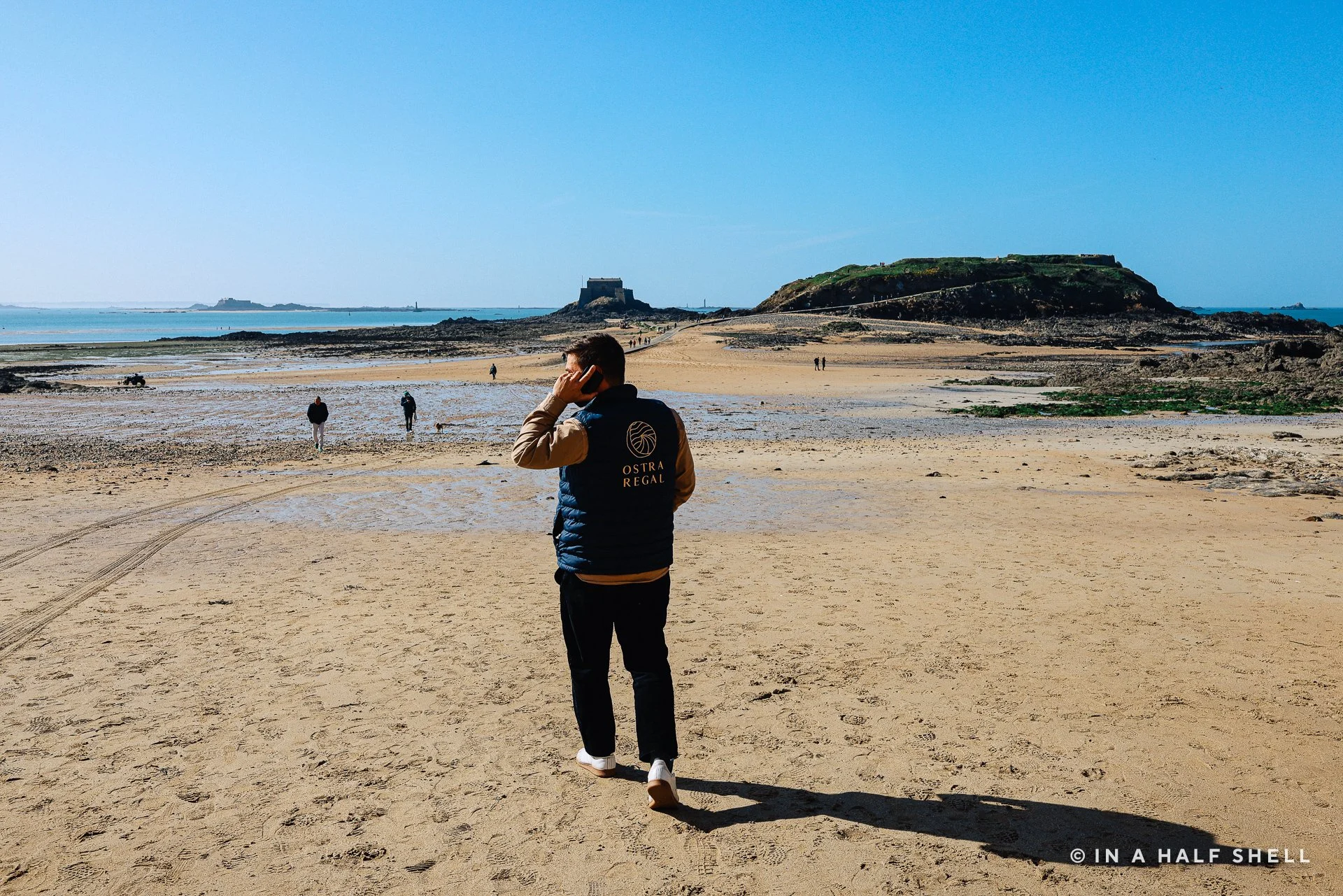
Brice Rollin leading the way to an epic razor clam dig in Saint-Malo.
Razor clam digging by Grand Bé, Saint-Malo
Upon arriving in Saint-Malo, Brice Rollin from La Famille Boutrais greeted me with two options: take a break at the company guest house or head straight to the tidal flats to dig for clams. Obviously, I chose the latter.
Brice grew up in Saint-Malo and knows these shores like the back of his hand. “I know a good spot,” he said as we crossed the sandy beach, heading toward what he promised was a clam-rich stretch. I couldn’t help but feel awe at the vast swaths of land laid bare by the receding tide.
We were near Grand Bé, a tidal island just off the historic town center, somewhat reminiscent of the world-famous Mont-Saint-Michel, though without the towering abbey. What it does have nearby is the iconic Bon-Secours seawater pool, built in 1936, where locals and visitors alike gather to swim, dive, and soak up the sun. Alas, it was still much too cold in April to enjoy.


Visitors exploring the vast tidal flats of Saint-Malo, France
Despite my love for razor clams, this was my first time actually foraging for them. I struggled to get the hang of it at first, but Brice made it look easy. Within minutes, he had a handful of good-sized clams. “This is a nice appetizer!” he joked.
The beach was dotted with people hunting for the same prize, but most weren’t in the right spot. The tide was already creeping back in, and Brice explained that the best clams were usually closer to the rocks.
What caught me off guard was that I heard them before I saw them: soft bubbling sounds, like tiny whispers under the sand. Then suddenly, a cold squirt of seawater hit my sneaker. There it was: the tip of a razor clam poking out just enough to resemble a little chimney with a tongue sticking out. The trick, Brice said, was to move fast—grab it and pull in one clean sweep before it could dig itself an escape route. We spent a good while clam stalking, trying to time it just right.
Aside from razor clams, the flats were teeming with other life: periwinkles, mud crabs, and sharp, unfriendly cockles. It was easy to get distracted, but we stayed on task and managed to collect about a dozen clams to sample on the spot. Brice rinsed the clams in a nearby tide pool, right next to the stone path that links Grand Bé to the mainland. No pocket knife, but he did have a spoon—which, surprisingly, worked well enough to pry the shells open. One more quick rinse, and then he handed me the cold, live clam to try.
OMG. It was divine. So clean, delicate, and fresh. And surprisingly, no grit! The texture was tender and flawless. I could’ve eaten three dozen if that had been an option. Just when I thought it couldn’t get any better, Brice had one more trick. He plucked a tuft of dulse seaweed to garnish the clam. It added just the right hit of salt, umami, and nuttiness. Absolutely delicious. What a strong first impression of Brittany this was!


Touring La Famille Boutrais’ processing facility and oyster tasting
The next morning, Brice gave me a tour of the processing facility, tucked among a row of oyster barns operated by neighboring growers. This industrial oyster park is about one kilometer south of the newly crowned three-Michelin-star restaurant Le Coquillage.
Much of the setup was familiar: wet storage, relay ponds, automated graders, tumblers, and vibrating sorters. But what stood out was Brice’s walk-through of their post-harvest grading process, which was more elaborate than what I’d seen elsewhere. That’s largely because La Famille Boutrais processes and markets multiple oyster brands from different production regions and countries. Their Brittany farm is actually a relatively recent acquisition, purchased about five years ago. Prior to that, the company focused exclusively on producing premium spéciale oysters in Ireland, sold under their internationally-recognized Ostra Regal brand.
The first step was shell shape grading. Oysters were visually sorted by a human into three categories: A (flawless queens), B (nearly perfects), C (a little warpy/wonky). Almost all of their brands don’t accept grade C, and even the one that does allows only a very small percentage.
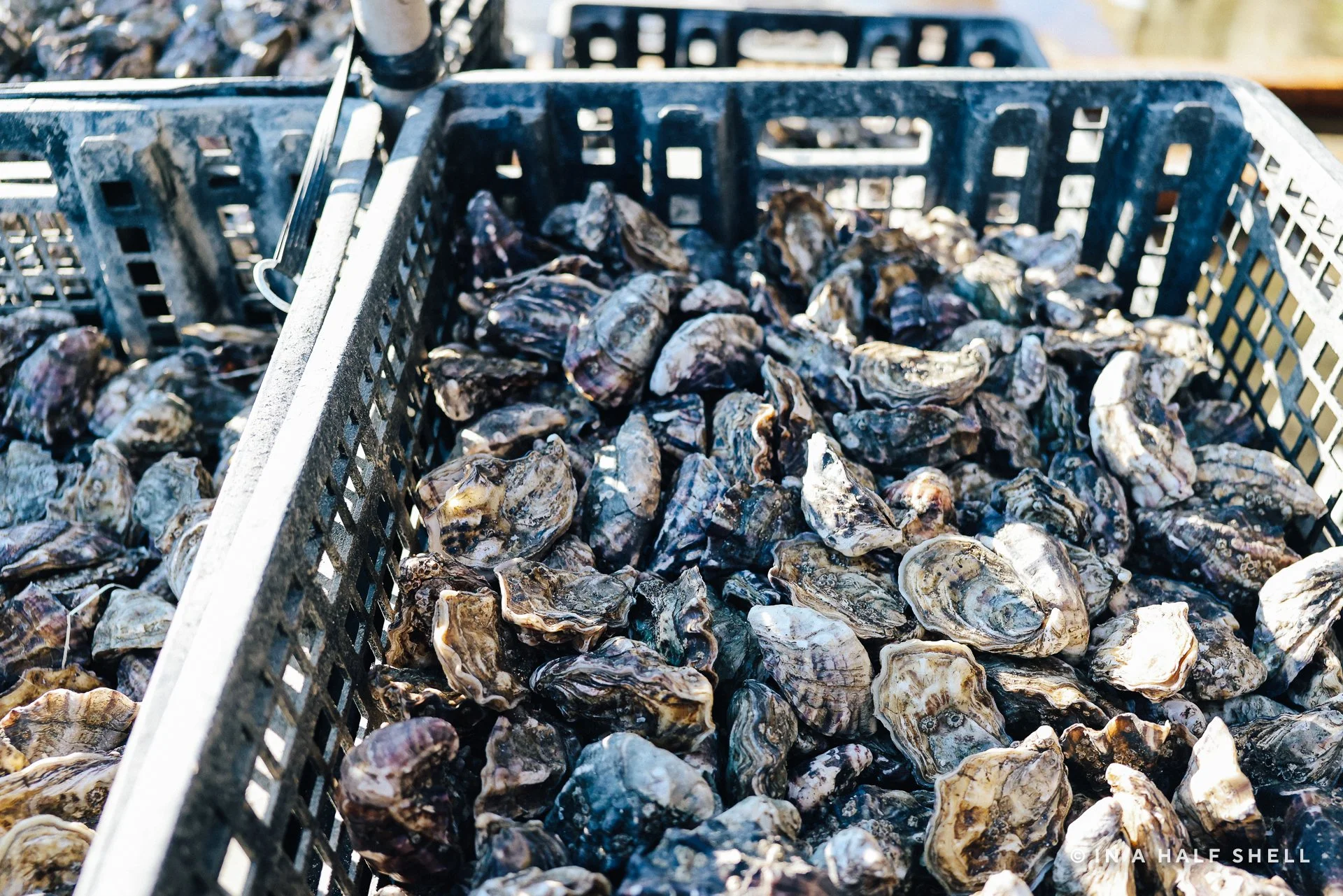
Next came grading by calibrated weight, using a circular machine from Mulot Equipment, a trusted French maker of shellfish gear. In France, oysters aren’t labeled “small,” “medium,” or “large.” Instead, they follow a numbering system where the lower the number, the heavier the oyster. While the system isn’t rigidly standardized, most producers within a region use similar ranges for what qualifies as a No. 0, 1, 2, and so on. The machine sorts each oyster accordingly, plunking it into the appropriate basket based on its weight class, which may shift slightly from year to year depending on the harvest.

Finally, the average meat-to-shell ratio is calculated by hand. Here’s how it works: the live, in-shell oyster is weighed on a digital scale. Then it’s carefully shucked, the liquor is discarded, and the meat is gently pressed to remove excess liquid before being weighed on its own. Time for some math: the meat-to-shell ratio is calculated by dividing the weight of the drained meat by the weight of the whole oyster, then multiplying by 100.
This final number helps determine whether the oyster is classified as a fine or a spéciale—a distinction unique to the French system for grading oysters. While there’s no rigid national standard, a fine typically has a ratio between 6.5 and 10.5. Anything above that qualifies as a spéciale. Some producers even go a step further, creating an ultra-premium category for their plumpest, most luxurious bivalves.
Does a higher meat-to-shell ratio imply a better oyster? Well, not necessarily. It really comes down to personal preference. Whether you lean toward silky, brinier oysters or meatier, umami-rich ones. Personally, I tend to favor oysters with higher ratios for both their taste and visual appeal. That said, there is such a thing as TOO much meat, especially with larger oysters (like No. 1s or 2s). In a raw oyster flight, they can start to feel overwhelming. Those big boys are often better suited for smoking, poaching, or frying.


Now for the fun part: tasting through the different brands with Brice, each one showcasing the distinct merroir and cultivation methods of its origin. While I’d sampled many of these oysters before, one stood out immediately. The newly developed Amulette oyster, still on the cusp of its international debut, was a revelation. Petite and deep-cupped, it had all the visual hallmarks of a refined spéciale, perfectly suited as an amuse-bouche.
But it was the flavor that really caught me off guard. On first slurp, a striking, smoky note emerged. It was vivid, unmistakable, and oddly specific, evoking the sensation of eating a slice of smoked salmon. This was not a flavor that’s easy to find in fresh, unadulterated raw oysters. Whatever volatile compound triggered that impression was fleeting. The aroma dissipated within a few chews and, curiously, was absent when I tasted a second oyster. My palate had seemingly acclimated, and the initial sensory signature vanished.
I’m no oyster physiologist or chemist, but I can’t help but wonder whether this kind of ephemeral aromatic effect might be linked to specific volatile compounds… perhaps aldehydes or phenols generated through unique metabolic or microbial interactions during the finishing or post-harvest process. It certainly seems to merit deeper chemical analysis. If that smoky note proves to be consistent and replicable, it could become a compelling and distinctive signature for the Amulette brand!


Side Quest: Getting Galettes & Hard Cider in Cancale

Jean d’Cancale, one of the several oyster vendors in Cancale, France
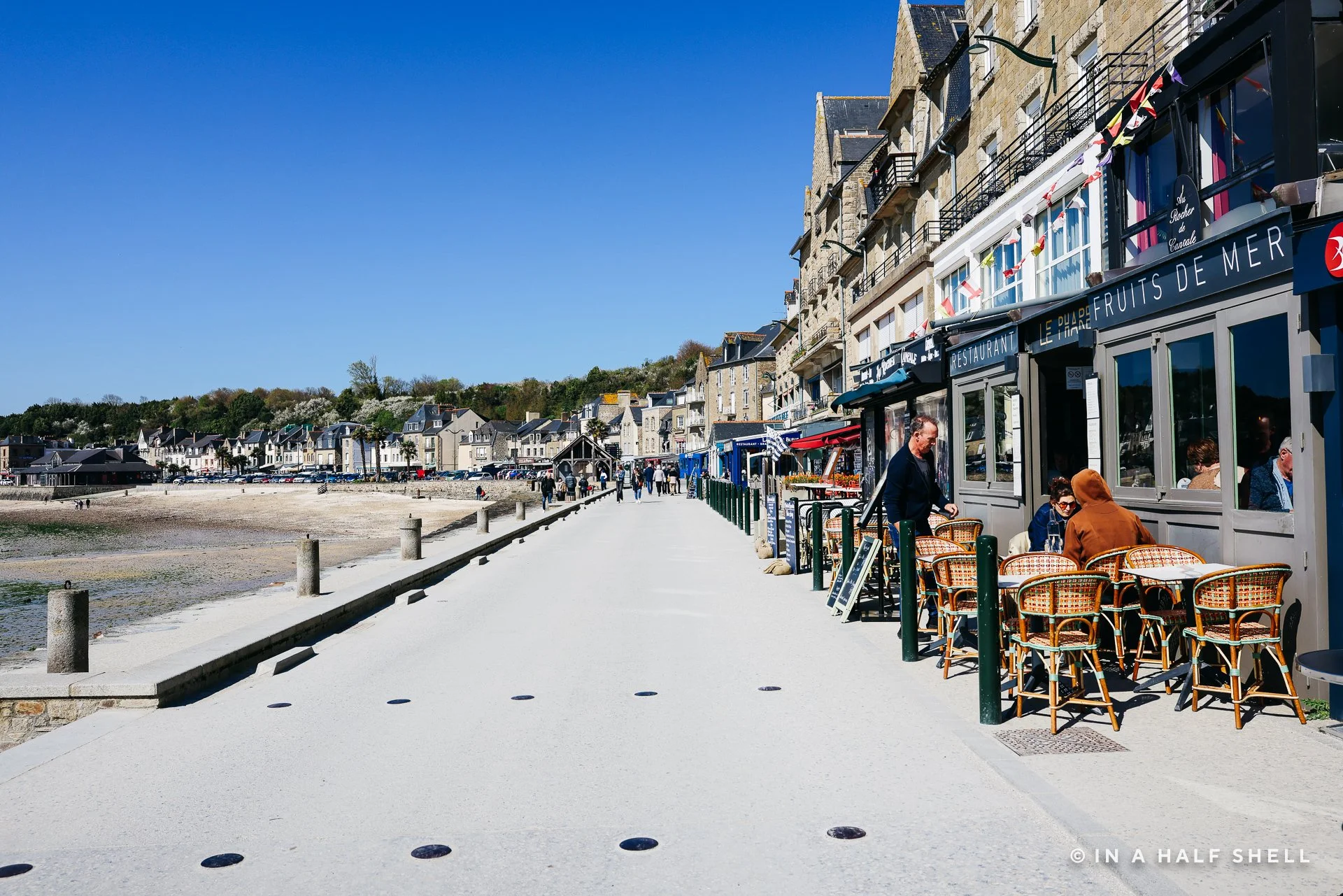
The boardwalk of Cancale on a sunny 1st of April.
After the processing facility tour, we had a bit of time to kill before I was due to head out to the tidal flat with the farm team. So Brice suggested a detour into Cancale to grab a bite. We made a quick pass through the little outdoor oyster market near the boat ramp, where five or six vendors were selling more or less the same lineup of fines in varying sizes. Tempting, but we’d just had amazing oysters and Brice had something else in mind.
He wanted to share another regional specialty: galettes, or buckwheat crêpes. We had a table reserved at Crêperie Breizh Café, a spot known for putting a fresh spin on this traditional dish. We ordered one of their seasonal specials, stuffed with local crab, and of course, the classic galette complète, paired with a crisp, dry cider. It was exquisite. If you’re ever in Cancale, I highly recommend stopping here for brunch before heading to the beach or oyster farm tour.
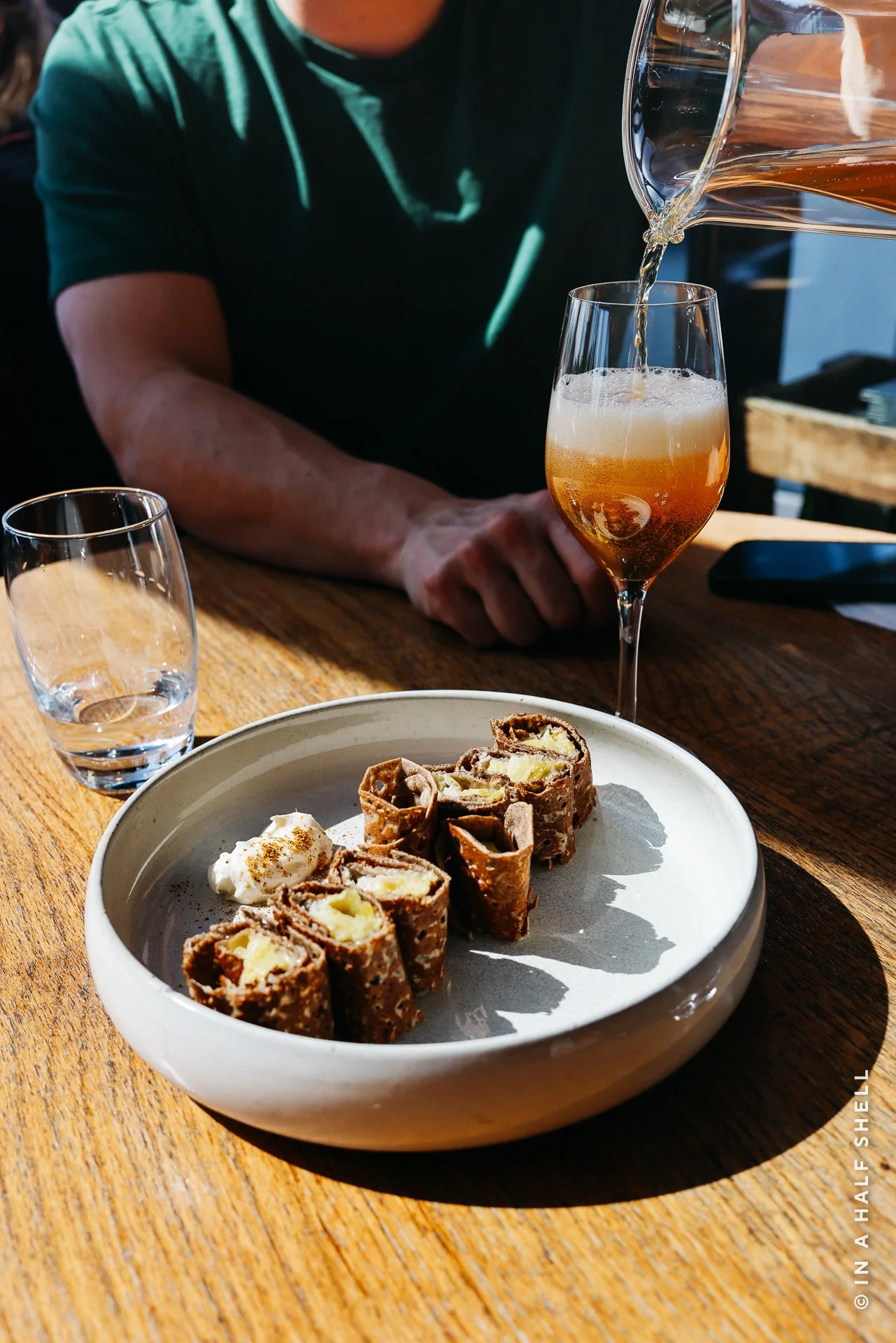
Enjoying crab filled galettes with some cold hard cider at Crêperie Breizh Café Cancale
Installing new oyster trestles in Mont Saint-Michel Bay
Upon returning to the processing facility, we were greeted by two giant tractors hauling flatbeds stacked high with rebar trestles, ready to roll. The entire farm crew was there, including both the grow-out and processing teams. It was all hands on deck for one of the most extreme tides of the year. Even Hugo Boutrais, the second-generation oyster farmer, was joining in on the fun.
I climbed onto the back of one of the flatbeds with the crew, and we rumbled down toward Le Vivier-sur-Mer. The drive took us past quiet villages, stretches of white sand, and even a blow karting track (which looked very fun, for the record).
With the tide nearly two kilometers out, the seascape took on an oddly agricultural feel. There was no water in sight—just vast stretches of packed sand and neat grids of trestles waiting for work. From this vantage point, oyster farming looked more like land farming: big amphibious tractors, flatbeds that double as boats, mesh bags filled with young oysters ready to be “planted.” It smelled like the sea, but it looked like a field.

Hugo Boutrais probably wondering if I’m going to be cut out for this.


We were standing where we should’ve been 12 meters underwater, yet the sun was shining on our faces. It felt a bit surreal to me, but for everyone else, it was business as usual.
There was a quiet urgency in the air. The team was anxious to get moving as they were planning to install new trestles on the outermost edge of the lease. This area only reveals itself during the most extreme tides, just twice a year. Once planted, they wouldn’t see those oysters again until September. In between, that entire stretch would remain inaccessible, submerged beneath the sea.
The tide was going out slower than expected, thanks to the gusty wind. Conditions weren’t ideal, but the job couldn’t wait. Pierre, a French football (plot twist: American football) player turned oyster farm manager, called the crew to action. It was time to start unloading the rebar trestles.
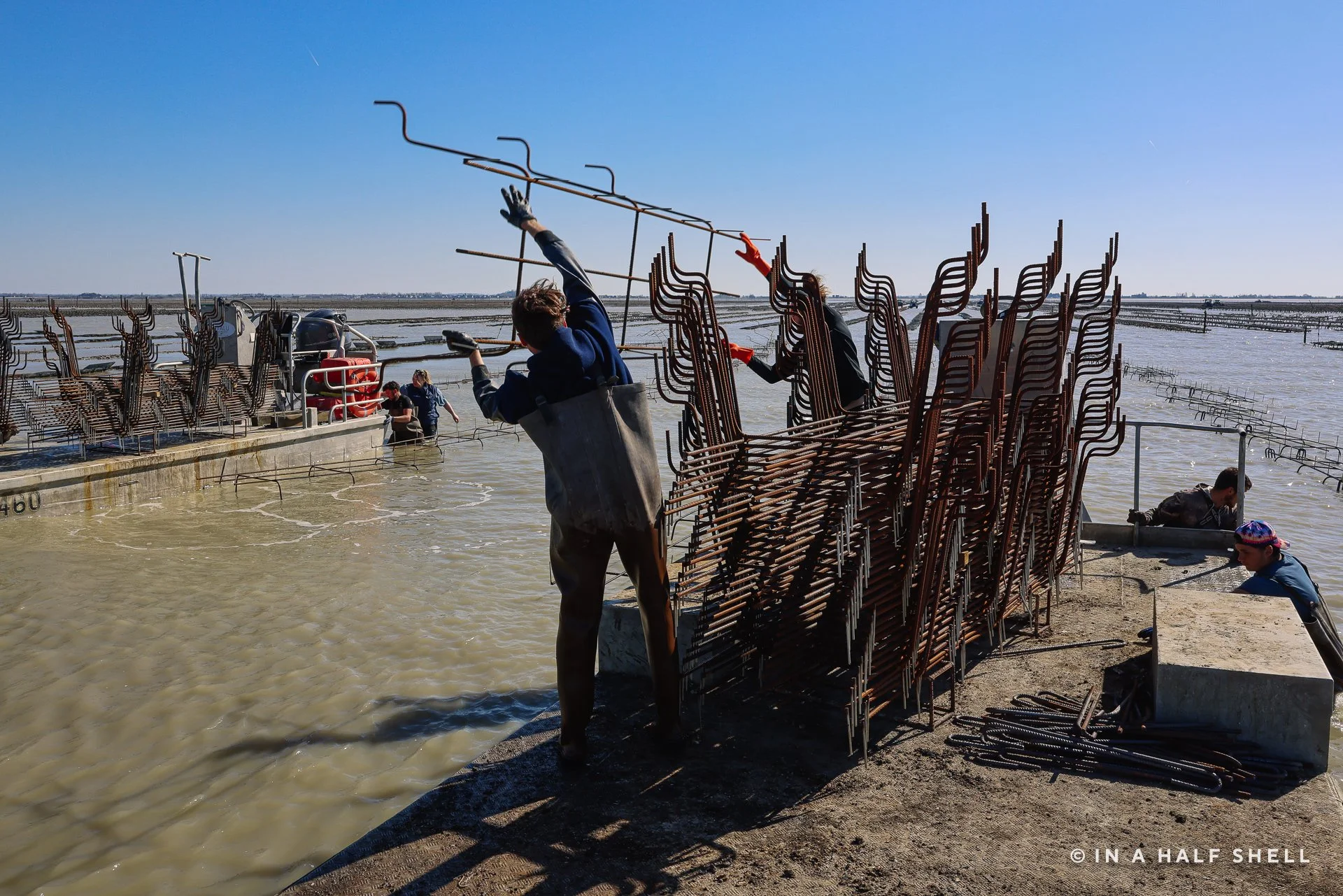
Oyster farmers flinging rebar trestles over their heads and into the water like it’s no big deal.
How? By heaving each one off the flatbed and flinging it onto the sand, trying to keep the lines as straight as possible. Once all the trestles were down, the team moved through to tidy and align them. This was where I could pitch in. I joined Hugo to straighten one row, and I think we did a pretty respectable job. The trestles weren’t especially heavy, but their long, awkward shape made them tricky to maneuver. We anchored each one into the seabed using U-shaped rebar pins.


There was something unexpectedly meditative about the task. The air felt cool and fresh, and the repetitive movements felt quietly satisfying. I really enjoyed working alongside Hugo while learning about his family business. It reminded me of kitchen prep work: important and deliberate. The physical toll wasn’t too bad either, though to be fair, I wasn’t the one lifting the rebar!
Next came the mesh oyster bags, filled with juvenile oysters from their nursery and half-grown farm in Ireland. A line of workers lifted them one by one and placed them onto the metal frames. In the distance, Mont-Saint-Michel hovered like a mirage on the horizon.
Then Hugo and the others moved quickly to secure the bags, stretching large rubber bands over the ends of the metal poles. It was all muscle memory. Some farmers were clearly faster and smoother than others (looking at you, Elise!).
Meanwhile, the tide had started to creep back in, reclaiming the flats. The crew picked up the pace, working at what felt like 1.5x speed to finish before the sea swallowed the farm again. The work was completed just in time.


It was so incredibly cool to tag along for the day and witness the level of teamwork and real-time problem-solving in action. The scale of oyster farming here is truly on another level, yet so much of it is still done by hand. Despite the size of the operation, there’s very little automation.
As we worked, I noticed other growers on either side using suspended long lines or floating systems. But La Famille Boutrais is sticking with the tried-and-true rack-and-bag method at their Brittany site, a choice that clearly reflects both tradition and intention.

La Famille Boutrais team installing new oyster bags and trestles on the outermost edge of their lease, roughly 2km offshore.


Spending these two days with La Famille Boutrais gave me a whole new appreciation for the precision, grit, and quiet pride that go into growing oysters at scale. It’s easy to romanticize the final product on a plate, but behind every perfect shell is a team working in rhythm with the tides, the elements, and each other. From the processing facility to the windswept flats, every step felt purposeful, practiced, and deeply rooted in place.
Special Thanks
A special thank you to Brice, Hugo, and the entire La Famille Boutrais team for letting me tag along and get my boots dirty. It was an unforgettable experience!
